Cost Guide
How Much Does a Custom Pool Cost in Los Angeles?
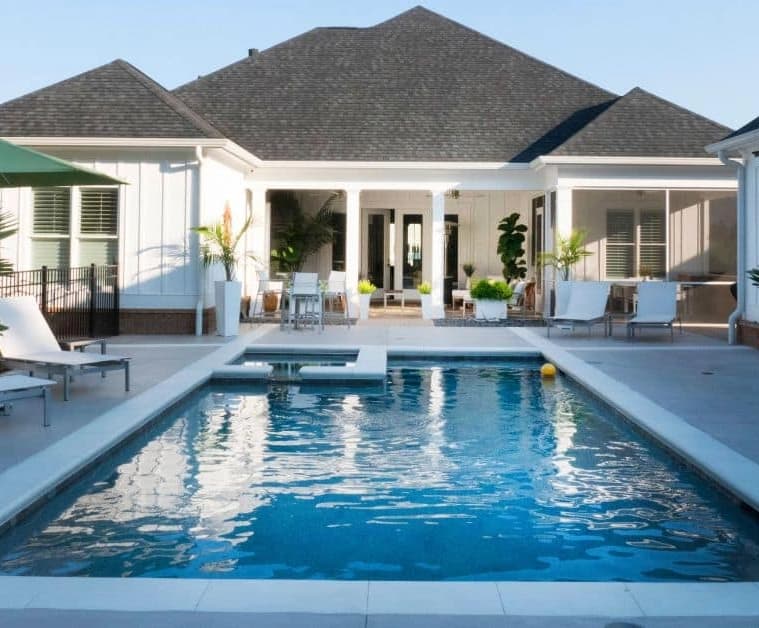
Pool costs in Los Angeles depend on size, shape, and the features you add around it. Here's a realistic breakdown by tier.
Standard pool & deck: $70,000–$100,000
A rectangular or freeform gunite pool with standard plaster finish, basic equipment, and a paver or concrete deck surround.
Pool with spa & features: $100,000–$150,000
Adds an attached spa, a Baja shelf or tanning ledge, water features like a sheer descent or bubbler, and upgraded plaster or pebble finish.
Resort-style backyard: $150,000+
A full outdoor living compound — pool, spa, natural stone decking, an outdoor kitchen, a cabana or pergola, and integrated landscape lighting.
What affects the price most
- Pool size and shape complexity
- Site access and excavation difficulty (slope, hillside lots)
- Plaster/finish grade and tile selection
- Decking material — pavers, natural stone, or stamped concrete
We also offer pool resurfacing and deck renovation for existing pools that don't need a full rebuild.
Pool finishes and equipment worth knowing about
The tier breakdown above is mostly about size and features. Within any tier, the shell, the finish and the equipment are where the detail sits — and where a meaningful part of both the build cost and the monthly running cost is decided.
The shell
- Gunite/shotcrete — sprayed concrete over steel reinforcement. Any shape, any depth, and effectively the standard for custom pools in Southern California. It's also the longest to build, because the shell has to cure before it can be finished.
- Fiberglass — a pre-molded shell lowered into the excavation. Much faster, and the smooth surface is easy on skin, but you're choosing from the manufacturer's shapes and sizes, and site access has to allow a one-piece shell to physically reach the yard.
- Vinyl liner — the least common of the three here. Lower up-front cost, and the liner is a replaceable wear item every several years.
Interior finish
- White plaster — the traditional and least expensive finish. It's also the shortest-lived, and it stains and etches more readily than the alternatives.
- Quartz-aggregate finishes — plaster with quartz added. More durable and more stain-resistant than plain plaster, with a slightly textured surface and a wider color range.
- Pebble finishes — small smooth stones set in the plaster matrix. The longest-lasting of the three, the most expensive, and the one that gives water the deep blue or green people associate with a resort pool. Polished pebble finishes are smoother underfoot than standard.
- Finish color — the color of the finish, not of the water, is what determines how a pool reads. A darker finish gives deeper blue water and absorbs more heat; a lighter finish gives a brighter, more turquoise look.
Tile, coping and decking
- Waterline tile — a band of tile at the water surface, where oils and scale collect and where the plaster finish would otherwise stain. Glass tile costs more than ceramic or porcelain but doesn't fade in sun or pool chemistry the way some ceramic glazes can.
- What's behind the tile — waterline tile is set in a polymer-modified thinset and grouted with a product rated for continuous submersion. Epoxy grout is common here, for the same reason it's used in a shower.
- Coping — the capped edge where the pool meets the deck. Precast concrete, natural stone and poured-in-place are the usual options; a bullnose edge is comfortable to sit on, and a cantilevered edge reads more modern.
- Decking — pavers, natural stone and stamped concrete are the most-installed. Two things matter more than appearance: slip resistance when wet, and how hot the surface gets in direct sun. Travertine and light-colored pavers stay notably cooler than dark stone or dark concrete.
Equipment
- Pump — variable-speed pumps use meaningfully less electricity than single-speed pumps, by running longer at a lower speed, and they're now the norm on new pools. This is the single equipment choice with the biggest effect on what the pool costs you each month.
- Filter — cartridge filters are the most common on new residential pools and use no water to backwash; sand filters are the least expensive and simplest; DE filters filter the finest and need the most attention.
- Sanitizing — a saltwater chlorine generator makes its own chlorine from dissolved salt. It costs more to install, the water is gentler on skin, hair and swimsuits, and it saves you handling chlorine directly. It is not a chlorine-free pool, which is a common misunderstanding. Supplemental UV or ozone systems reduce chlorine demand further.
- Heating — a gas heater heats fastest and is the right choice for a spa you want hot on demand; an electric heat pump costs more up front and far less to run, but heats slowly and loses effectiveness on cold nights; solar heating is cheapest to run and depends entirely on roof area and sun.
- Automation and lighting — a controller that runs pump speed, heater, lights and water features from a phone. Color-changing LED lights have replaced incandescent almost entirely.
- Cover — an automatic safety cover is a real cost and pays part of it back in heat and evaporation saved. It has to be designed into the deck and coping, not added afterwards.
Safety requirements
California requires residential pools to include safety features drawn from a defined list — enclosure fencing with self-closing, self-latching gates, approved safety covers, door and gate alarms, and similar. The specific requirements and how many features are needed have changed over the years and are also affected by local ordinance, so we confirm what applies to your property during design rather than working from a rule of thumb. Drain covers and suction outlets are also subject to their own federal safety standard, which any new pool is built to.
Planning the whole yard, not just the pool? See our backyard remodel cost guide for the full picture. We don't yet have a filmed pool project in our case studies — see our project gallery for finished work in the meantime.