Cost Guide
How Much Does a Backyard Remodel Cost in Los Angeles?
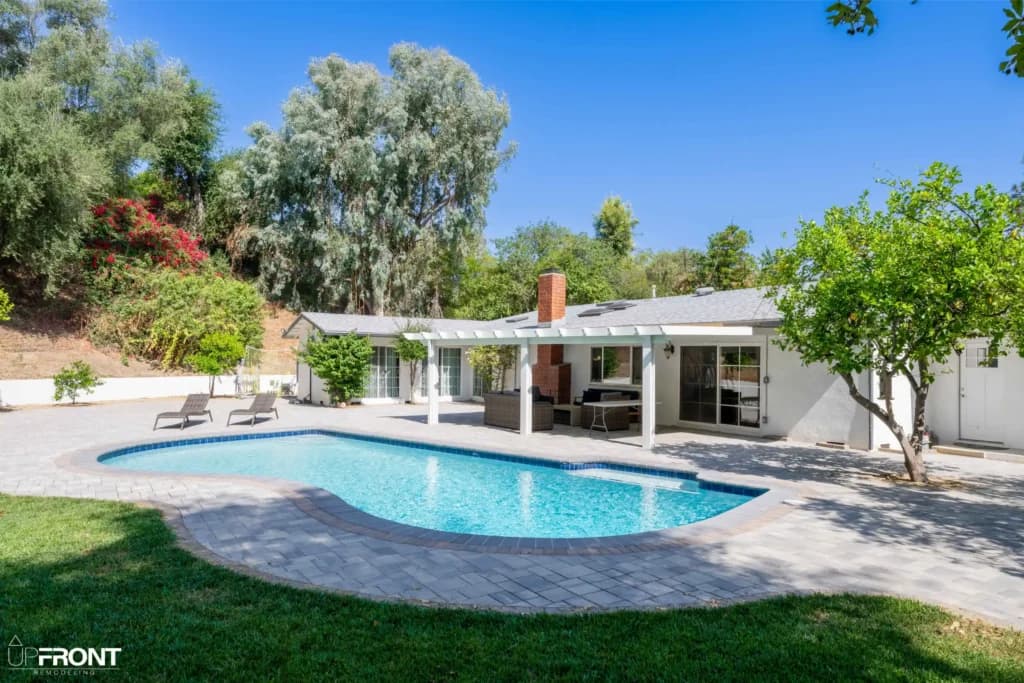
Backyard remodel costs vary more than almost any other project type because the scope can range from a simple patio refresh to a full outdoor living compound with a pool and kitchen. Here's how the budget typically breaks down.
Patio & landscaping refresh: $25,000–$45,000
New pavers or stamped concrete, updated planting beds, irrigation, and basic landscape lighting. This tier makes the biggest visual difference for the smallest investment.
Outdoor living upgrade: $45,000–$90,000
Adds a fire pit or fireplace, a pergola or shade structure, a built-in outdoor kitchen, and upgraded hardscape throughout the yard.
Full transformation with pool: $150,000+
Combines a custom pool and spa, full hardscape and landscape redesign, an outdoor kitchen, and structures like a cabana or pergola into one cohesive space.
What drives the cost
- Square footage of hardscape vs. planting area
- Whether a pool or spa is included
- Grading and drainage work needed on sloped lots
- Custom structures — pergolas, cabanas, outdoor kitchens
See a complete backyard transformation in Tarzana for a real example of a full-scope project.
Materials and fixtures worth knowing about
Backyard budgets are driven by square footage more than by any single material choice, but the materials below are where that square footage goes. A few of them — drainage, and the base under the paving — are invisible when the job is done, and they're the first things cut from a low bid.
Hardscape and paving
- Pavers — concrete or stone units set on a compacted base. Their real advantage is repairability: if a section settles or a tree root lifts it, that section is taken up and reset without a visible patch.
- Poured and stamped concrete — less expensive per square foot over a large area, and stamping can imitate stone or wood plank. It will eventually crack; control joints decide where.
- Natural stone — flagstone, bluestone or travertine. The most expensive and the least uniform, which is the point. Travertine stays notably cooler underfoot in sun, which is why it's common around pools.
- Decomposed granite and gravel — the least expensive surface, permeable, and good for informal paths and seating areas. It needs edging to stay where it was put, and stabilized DG holds together far better than loose.
- The base underneath — compacted aggregate to the right depth is what determines whether a patio is still flat in ten years. It's entirely invisible, and it's where cheap work is cheap.
Decking
- Composite — wood fiber and plastic. Costs more up front, never needs staining or sealing, and doesn't splinter. The most common choice now for a deck that will see bare feet.
- Hardwood — ipe, cumaru and similar tropical hardwoods are dense, extremely durable and beautiful, and need oiling to keep their color rather than weathering to gray.
- Pressure-treated softwood — the least expensive, and the one that asks for the most ongoing maintenance.
- Framing and footings — the substructure, not the deck boards, determines how long a deck lasts. Any deck more than a low step off the ground is also a permit and railing question.
Outdoor kitchen
- Cabinetry — marine-grade stainless or an outdoor-rated polymer. Standard indoor cabinetry doesn't survive outdoors, even under a cover.
- Counter — granite and porcelain slab handle sun and weather well. Quartz is generally not recommended in full sun because the resin binding it can discolor over time, though this varies by brand and is worth checking against the specific product.
- Appliances — a built-in grill is the core; side burners, a pizza oven, a refrigerator, a sink and a ventilation hood (needed if the grill sits under a solid roof) are the common additions. Each one is a gas, water or electrical run that has to be trenched before the hardscape goes down.
Fire, shade and light
- Fire features — gas fire pits and fireplaces light instantly and need no cleanup; wood-burning versions cost less to build but need more maintenance and are restricted in some jurisdictions, particularly during fire season. Confirm locally before designing around one.
- Shade structures — a fixed pergola in wood, aluminum or vinyl is the lower-cost option; a louvered-roof pergola adjusts from open to fully shaded and can close against rain; a solid-roof patio cover is effectively an addition and is permitted like one.
- Lighting — low-voltage landscape lighting along paths and into planting is standard on nearly every project; step and wall lights are a safety item rather than a decorative one; string lighting over a patio is the least expensive change that most alters how the space gets used after dark.
Planting, irrigation and drainage
- Planting — drought-tolerant and California-native planting is the sensible default here, grouped by water need so one zone isn't overwatered to keep another alive.
- Irrigation — drip for beds, rotors or spray for lawn, on a smart controller that adjusts to the weather. Converting old spray heads in planting beds over to drip is one of the cheapest water savings available.
- Turf — natural lawn needs water and mowing; artificial turf costs more up front, needs a proper drainage base beneath it, and gets hot in direct sun.
- Drainage and grading — area drains, French drains, and a positive slope away from the house. On a sloped lot this is the single most important part of the project and the least visible.
- Retaining walls — block, poured concrete, or stone-faced. Above a certain height they need engineering and a permit; that threshold varies by jurisdiction, so we confirm it for your project rather than assume it.
- Fencing — wood is least expensive and needs the most upkeep; vinyl needs almost none; horizontal slat fencing reads modern and costs more in labor; wrought iron lasts longest.
Adding a pool to the project? See our custom pool cost guide for how that changes the budget.